Closing Techstars’ Data Gap Through Founder-Centric CRM Design
Web Application
My Role:
Design & Research Lead
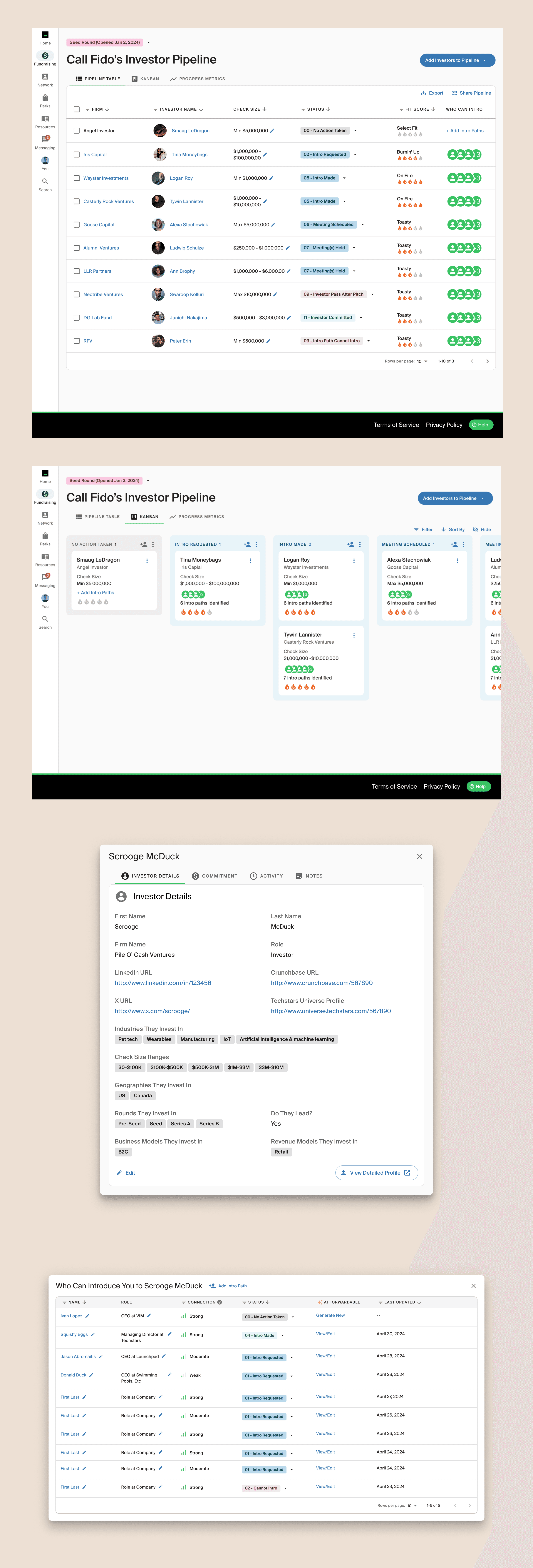
The Techstars Universe Limitless Investor Pipeline (TULIP) is a fundraising CRM (customer relationship management) tool that Techstars founders can use to keep track of investor leads for fundraising.
Define
Challenges
Techstars gets inaccurate, incomplete fundraising data from founders, even though founders are required to report the details of their fundraise as part of their agreement to receive Techstars funding.
Only about 20% of all fundraises are reported to Techstars. Techstars finds out about the rest indirectly through other sources such as Crunchbase and Pitchbook.
Fundraising was identified as one of the biggest pain points for a founder. It is time consuming and manual.
Opportunities
If we build a platform that integrates into the founder’s existing fundraising process and meets their needs, TULIP eliminates the needs for a founder to use more tools, increases the likelihood they’ll use TULIP and provide accurate fundraising data to Techstars, and saves them time in the process with AI and integration with other data sources.
Success was measured by an increase in percentage of fundraising activities reported to Techstars and number of fundraising pipelines using TULIP.
Research
Understanding the Problem
I conducted user interviews with 17 Techstars founders who were either in the process of fundraising or had recently completed a fundraising round. I also spoke to stakeholders in the company about their challenges and goals for this project, as well as Techstars investors, to get a full picture of how fundraising works from all perspectives.
Key Insights
90% had identified fundraising as the biggest pain point in their entire journey as a founder
Fundraising is a very manual and time consuming process that is basically a full-time job for one founder.
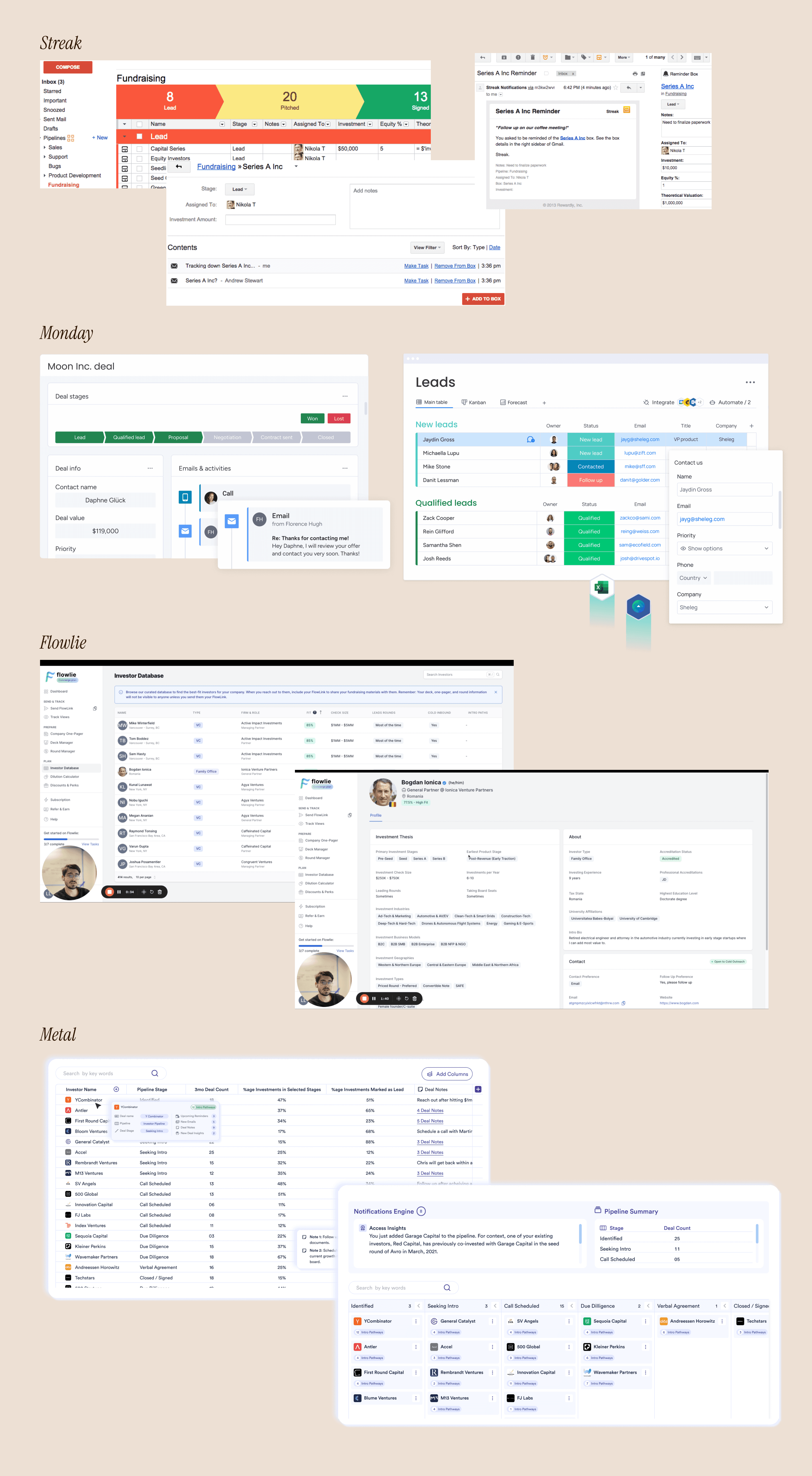
Founders use a variety of tools such as Airtable, Google Sheets, or Trello along with Crunchbase and LinkedIn to identify investor leads. They then go through their network to see who knows the investor and can introduce them to the investor, which is called a warm introduction.
Competitive Analysis
User flow
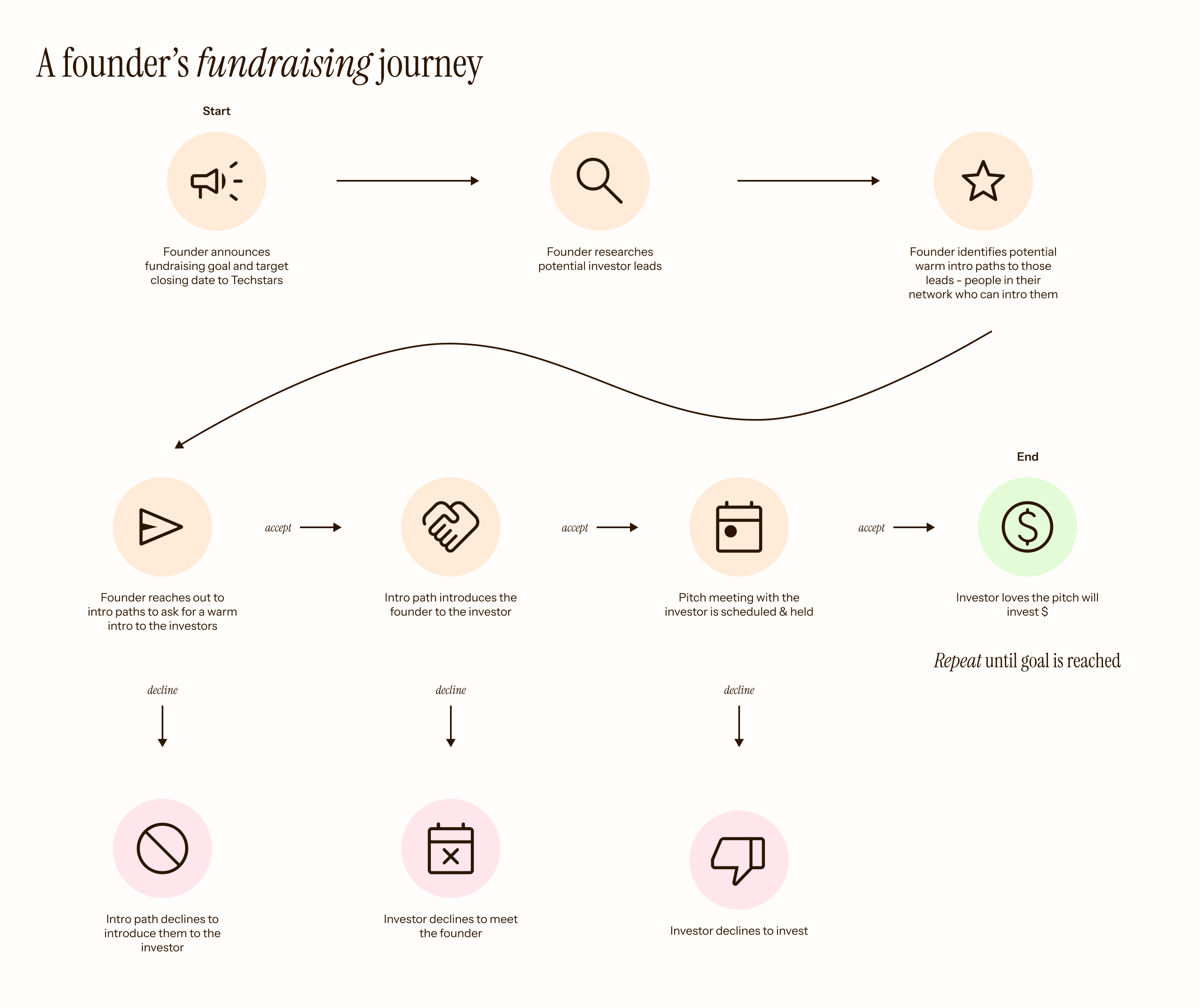
I mapped out a founder user's fundraising journey to understand where TULIP would fit into their current process.
Why are warm intros so important? Why not just directly contact the investor?
In the venture capital world, founders generally have a higher rate of success in getting a meeting with an investor and landing the investment if they are introduced by someone who can vouch for them and their business to the investor.
User interviews with investors also confirmed that investors will generally not respond to cold emails from founders they do not know or who were not introduced to them by their network. Investors are looking for quality leads and trust their network the most to get those leads.
Design
Iterations
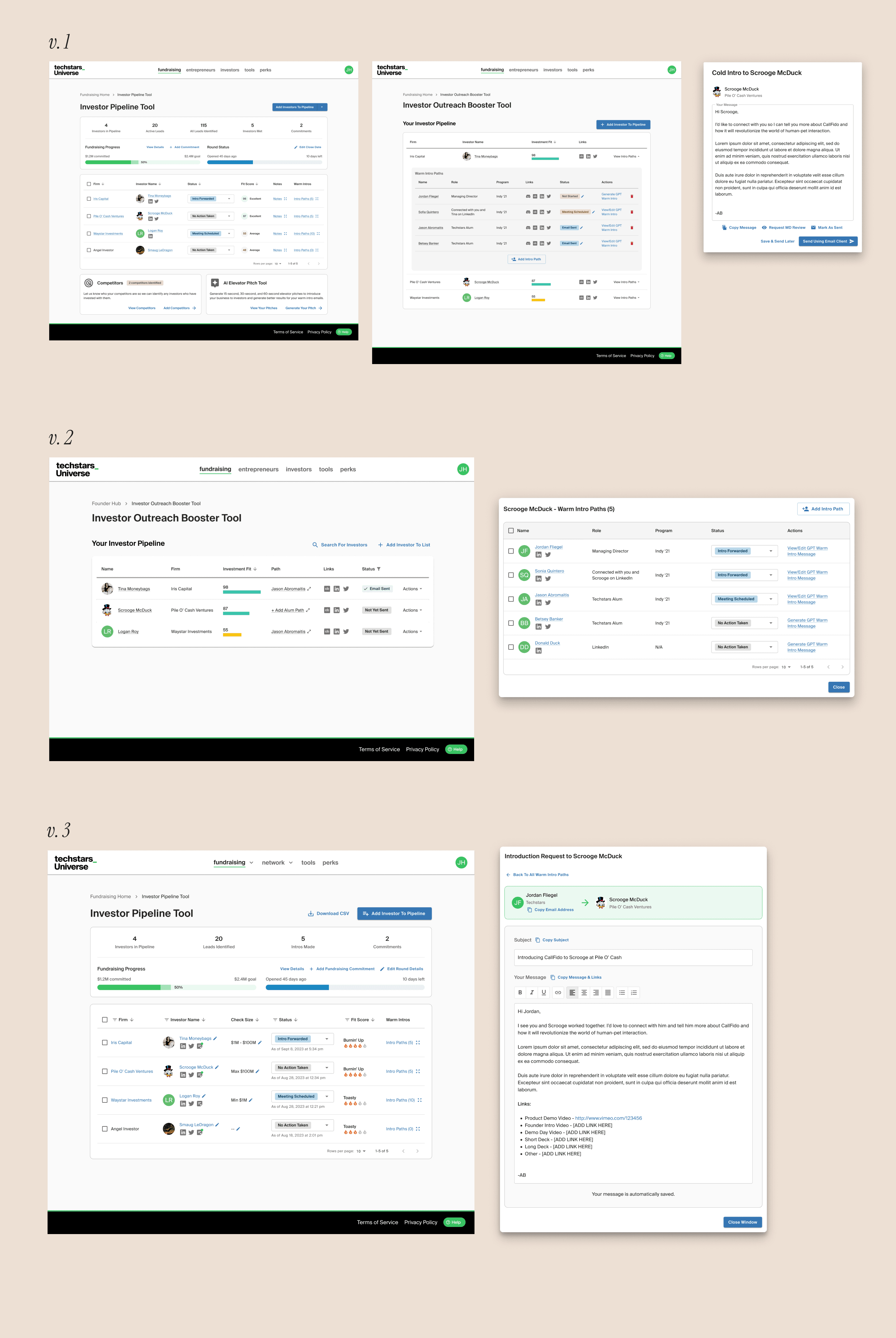
During the user interviews, founders shared their current processes and tools - some even shared their screens with me. Most of them either use a spreadsheet (like Google Sheets or Airtable) or a kanban board (like Trello) to keep track of their investor leads and warm intros. Since it was format that users were already familiar with, I started out with using the spreadsheet format as the template. (A kanban view was eventually added to the roadmap.)
The table was populated with investor details from Techstars data, as well as Crunchbase, that a founder found relevant to determining whether an investor was a good fit or not. We had usability testing sessions with several founders to refine the data in the table and the functionality.
The warm intros for each investor were initially shown as expandable sections under each investor row item. However, users found this confusing and too busy so eventually, the warm intro table moved into a modal.
Designing for AI
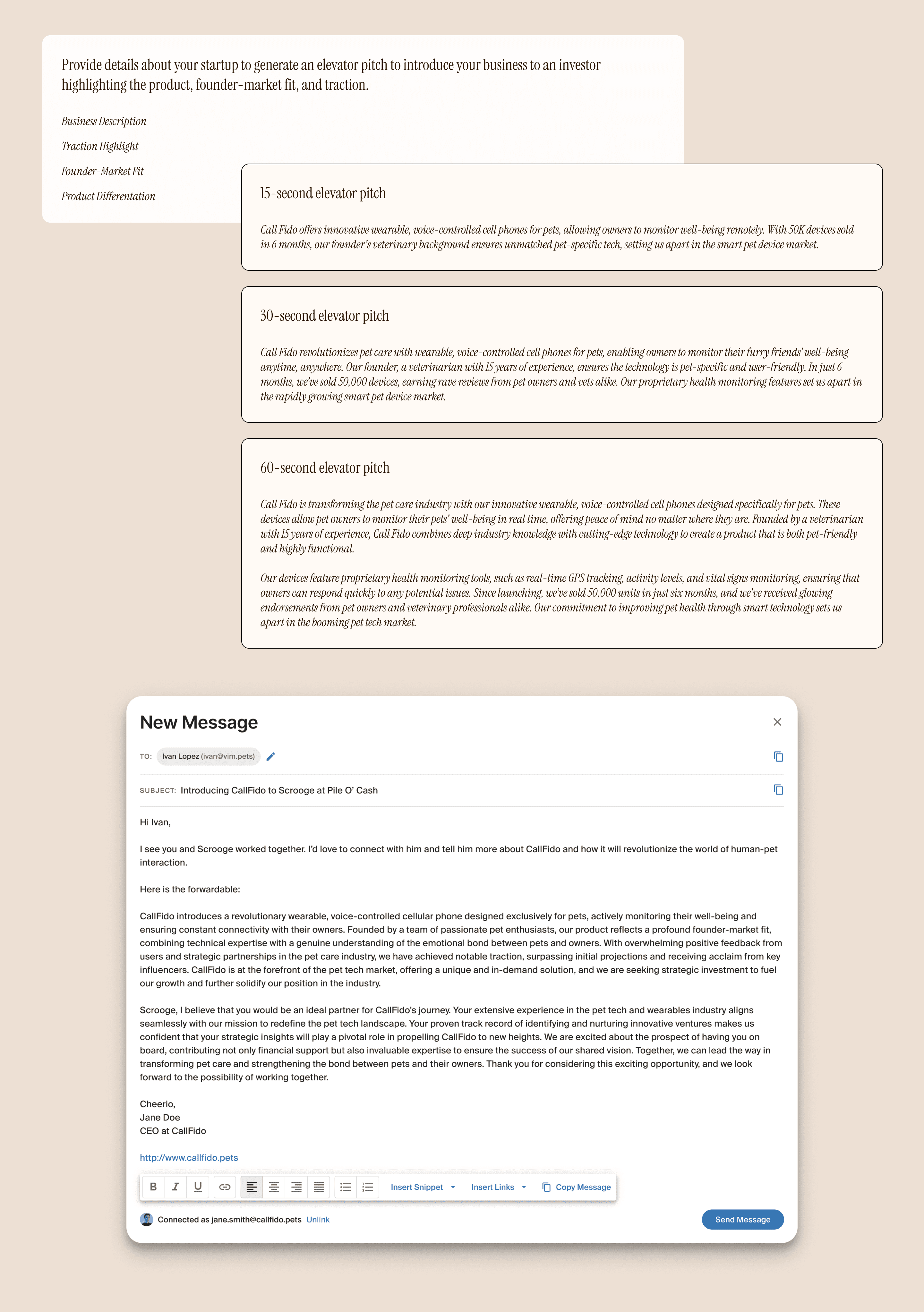
Conversations with Techstars program teams, managing directors, and mentors revealed that having a compelling elevator pitch and deck were important to generating interest in a founder’s business. However, a lot of founders struggled with this even if the rest of their business plan was solid. Most founders did not have copywriting experience. This was where AI came into play.
In research sessions where founders were asked to choose between an elevator pitch that they wrote vs. one that was generated by ChatGPT, founder overwhelmingly chose the AI generated one. This led to the team developing our own AI tools to help founders generate an elevator pitch based on information Techstars had about their business, as well as any information provided by the founder, as such product-market fit, founding team, etc.
AI was also used to generate emails to the warm intro path that explained why the founder wanted the investor intro and why they thought this person was the best to introduce them to the investor.
After the AI elevator pitch and email forwardable was generated, founders could send the email off to their warm intro, who could then forward the founder’s email with a quality elevator pitch, to the investor. This would save founders countless hours of writing bad elevator pitches and preparing for meetings only to get rejected by investors.
Implementation
Impact
After TULIP was launched, the percentage of fundraising activities reported to Techstars jumped to 20% from 40%.
Program teams and managing directors praised TULIP as “one of the most valuable tools that the Engineering team has built” and encouraged their founders to use it. Founders have also said:
"Having a better way to organize fundraising efforts would free up more of my time for building relationships with investors."
" Can't wait for this to be live. I need to organize better my pipeline and process, in order to run a right process."
"I need a warm intro tool so much that I wrote a 3-page Google doc in our last round about how painful booking calls with investors is."
"Navigating investments is a whirlwind, where maps gather dust faster than you can say 'unicorn.' To find your north star in fundraising, it's all about research, relationship management and warm intros. And Techstars gives you the universe and all the tools to do that."
Closing Techstars’ Data Gap Through Founder-Centric CRM Design
Web Application
My Role:
Design & Research Lead
The Techstars Universe Limitless Investor Pipeline (TULIP) is a fundraising CRM (customer relationship management) tool that Techstars founders can use to keep track of investor leads for fundraising.
Define
Challenges
Techstars gets inaccurate, incomplete fundraising data from founders, even though founders are required to report the details of their fundraise as part of their agreement to receive Techstars funding.
Only about 20% of all fundraises are reported to Techstars. Techstars finds out about the rest indirectly through other sources such as Crunchbase and Pitchbook.
Fundraising was identified as one of the biggest pain points for a founder. It is time consuming and manual.
Opportunities
If we build a platform that integrates into the founder’s existing fundraising process and meets their needs, TULIP eliminates the needs for a founder to use more tools, increases the likelihood they’ll use TULIP and provide accurate fundraising data to Techstars, and saves them time in the process with AI and integration with other data sources.
Success was measured by an increase in percentage of fundraising activities reported to Techstars and number of fundraising pipelines using TULIP.
Research
Understanding the Problem
I conducted user interviews with 17 Techstars founders who were either in the process of fundraising or had recently completed a fundraising round. I also spoke to stakeholders in the company about their challenges and goals for this project, as well as Techstars investors, to get a full picture of how fundraising works from all perspectives.
Key Insights
90% had identified fundraising as the biggest pain point in their entire journey as a founder
Fundraising is a very manual and time consuming process that is basically a full-time job for one founder.
Founders use a variety of tools such as Airtable, Google Sheets, or Trello along with Crunchbase and LinkedIn to identify investor leads. They then go through their network to see who knows the investor and can introduce them to the investor, which is called a warm introduction.
Competitive Analysis
User flow
I mapped out a founder user's fundraising journey to understand where TULIP would fit into their current process.
Why are warm intros so important? Why not just directly contact the investor?
In the venture capital world, founders generally have a higher rate of success in getting a meeting with an investor and landing the investment if they are introduced by someone who can vouch for them and their business to the investor.
User interviews with investors also confirmed that investors will generally not respond to cold emails from founders they do not know or who were not introduced to them by their network. Investors are looking for quality leads and trust their network the most to get those leads.
Design
Iterations
During the user interviews, founders shared their current processes and tools - some even shared their screens with me. Most of them either use a spreadsheet (like Google Sheets or Airtable) or a kanban board (like Trello) to keep track of their investor leads and warm intros. Since it was format that users were already familiar with, I started out with using the spreadsheet format as the template. (A kanban view was eventually added to the roadmap.)
The table was populated with investor details from Techstars data, as well as Crunchbase, that a founder found relevant to determining whether an investor was a good fit or not. We had usability testing sessions with several founders to refine the data in the table and the functionality.
The warm intros for each investor were initially shown as expandable sections under each investor row item. However, users found this confusing and too busy so eventually, the warm intro table moved into a modal.
Designing for AI
Conversations with Techstars program teams, managing directors, and mentors revealed that having a compelling elevator pitch and deck were important to generating interest in a founder’s business. However, a lot of founders struggled with this even if the rest of their business plan was solid. Most founders did not have copywriting experience. This was where AI came into play.
In research sessions where founders were asked to choose between an elevator pitch that they wrote vs. one that was generated by ChatGPT, founder overwhelmingly chose the AI generated one. This led to the team developing our own AI tools to help founders generate an elevator pitch based on information Techstars had about their business, as well as any information provided by the founder, as such product-market fit, founding team, etc.
AI was also used to generate emails to the warm intro path that explained why the founder wanted the investor intro and why they thought this person was the best to introduce them to the investor.
After the AI elevator pitch and email forwardable was generated, founders could send the email off to their warm intro, who could then forward the founder’s email with a quality elevator pitch, to the investor. This would save founders countless hours of writing bad elevator pitches and preparing for meetings only to get rejected by investors.
Implementation
Impact
After TULIP was launched, the percentage of fundraising activities reported to Techstars jumped to 20% from 40%.
Program teams and managing directors praised TULIP as “one of the most valuable tools that the Engineering team has built” and encouraged their founders to use it. Founders have also said:
"Having a better way to organize fundraising efforts would free up more of my time for building relationships with investors."
" Can't wait for this to be live. I need to organize better my pipeline and process, in order to run a right process."
"I need a warm intro tool so much that I wrote a 3-page Google doc in our last round about how painful booking calls with investors is."
"Navigating investments is a whirlwind, where maps gather dust faster than you can say 'unicorn.' To find your north star in fundraising, it's all about research, relationship management and warm intros. And Techstars gives you the universe and all the tools to do that."
Closing Techstars’ Data Gap Through Founder-Centric CRM Design
Web Application
My Role:
Design & Research Lead
The Techstars Universe Limitless Investor Pipeline (TULIP) is a fundraising CRM (customer relationship management) tool that Techstars founders can use to keep track of investor leads for fundraising.
Define
Challenges
Techstars gets inaccurate, incomplete fundraising data from founders, even though founders are required to report the details of their fundraise as part of their agreement to receive Techstars funding.
Only about 20% of all fundraises are reported to Techstars. Techstars finds out about the rest indirectly through other sources such as Crunchbase and Pitchbook.
Fundraising was identified as one of the biggest pain points for a founder. It is time consuming and manual.
Opportunities
If we build a platform that integrates into the founder’s existing fundraising process and meets their needs, TULIP eliminates the needs for a founder to use more tools, increases the likelihood they’ll use TULIP and provide accurate fundraising data to Techstars, and saves them time in the process with AI and integration with other data sources.
Success was measured by an increase in percentage of fundraising activities reported to Techstars and number of fundraising pipelines using TULIP.
Research
Understanding the Problem
I conducted user interviews with 17 Techstars founders who were either in the process of fundraising or had recently completed a fundraising round. I also spoke to stakeholders in the company about their challenges and goals for this project, as well as Techstars investors, to get a full picture of how fundraising works from all perspectives.
Key Insights
90% had identified fundraising as the biggest pain point in their entire journey as a founder
Fundraising is a very manual and time consuming process that is basically a full-time job for one founder.
Founders use a variety of tools such as Airtable, Google Sheets, or Trello along with Crunchbase and LinkedIn to identify investor leads. They then go through their network to see who knows the investor and can introduce them to the investor, which is called a warm introduction.
Competitive Analysis
User flow
I mapped out a founder user's fundraising journey to understand where TULIP would fit into their current process.
Why are warm intros so important? Why not just directly contact the investor?
In the venture capital world, founders generally have a higher rate of success in getting a meeting with an investor and landing the investment if they are introduced by someone who can vouch for them and their business to the investor.
User interviews with investors also confirmed that investors will generally not respond to cold emails from founders they do not know or who were not introduced to them by their network. Investors are looking for quality leads and trust their network the most to get those leads.
Design
Iterations
During the user interviews, founders shared their current processes and tools - some even shared their screens with me. Most of them either use a spreadsheet (like Google Sheets or Airtable) or a kanban board (like Trello) to keep track of their investor leads and warm intros. Since it was format that users were already familiar with, I started out with using the spreadsheet format as the template. (A kanban view was eventually added to the roadmap.)
The table was populated with investor details from Techstars data, as well as Crunchbase, that a founder found relevant to determining whether an investor was a good fit or not. We had usability testing sessions with several founders to refine the data in the table and the functionality.
The warm intros for each investor were initially shown as expandable sections under each investor row item. However, users found this confusing and too busy so eventually, the warm intro table moved into a modal.
Designing for AI
Conversations with Techstars program teams, managing directors, and mentors revealed that having a compelling elevator pitch and deck were important to generating interest in a founder’s business. However, a lot of founders struggled with this even if the rest of their business plan was solid. Most founders did not have copywriting experience. This was where AI came into play.
In research sessions where founders were asked to choose between an elevator pitch that they wrote vs. one that was generated by ChatGPT, founder overwhelmingly chose the AI generated one. This led to the team developing our own AI tools to help founders generate an elevator pitch based on information Techstars had about their business, as well as any information provided by the founder, as such product-market fit, founding team, etc.
AI was also used to generate emails to the warm intro path that explained why the founder wanted the investor intro and why they thought this person was the best to introduce them to the investor.
After the AI elevator pitch and email forwardable was generated, founders could send the email off to their warm intro, who could then forward the founder’s email with a quality elevator pitch, to the investor. This would save founders countless hours of writing bad elevator pitches and preparing for meetings only to get rejected by investors.
Implementation
Impact
After TULIP was launched, the percentage of fundraising activities reported to Techstars jumped to 20% from 40%.
Program teams and managing directors praised TULIP as “one of the most valuable tools that the Engineering team has built” and encouraged their founders to use it. Founders have also said:
"Having a better way to organize fundraising efforts would free up more of my time for building relationships with investors."
" Can't wait for this to be live. I need to organize better my pipeline and process, in order to run a right process."
"I need a warm intro tool so much that I wrote a 3-page Google doc in our last round about how painful booking calls with investors is."
"Navigating investments is a whirlwind, where maps gather dust faster than you can say 'unicorn.' To find your north star in fundraising, it's all about research, relationship management and warm intros. And Techstars gives you the universe and all the tools to do that."
Closing Techstars’ Data Gap Through Founder-Centric CRM Design
Web Application
My Role:
Design & Research Lead
The Techstars Universe Limitless Investor Pipeline (TULIP) is a fundraising CRM (customer relationship management) tool that Techstars founders can use to keep track of investor leads for fundraising.
Define
Challenges
Techstars gets inaccurate, incomplete fundraising data from founders, even though founders are required to report the details of their fundraise as part of their agreement to receive Techstars funding.
Only about 20% of all fundraises are reported to Techstars. Techstars finds out about the rest indirectly through other sources such as Crunchbase and Pitchbook.
Fundraising was identified as one of the biggest pain points for a founder. It is time consuming and manual.
Opportunities
If we build a platform that integrates into the founder’s existing fundraising process and meets their needs, TULIP eliminates the needs for a founder to use more tools, increases the likelihood they’ll use TULIP and provide accurate fundraising data to Techstars, and saves them time in the process with AI and integration with other data sources.
Success was measured by an increase in percentage of fundraising activities reported to Techstars and number of fundraising pipelines using TULIP.
Research
Understanding the Problem
I conducted user interviews with 17 Techstars founders who were either in the process of fundraising or had recently completed a fundraising round. I also spoke to stakeholders in the company about their challenges and goals for this project, as well as Techstars investors, to get a full picture of how fundraising works from all perspectives.
Key Insights
90% had identified fundraising as the biggest pain point in their entire journey as a founder
Fundraising is a very manual and time consuming process that is basically a full-time job for one founder.
Founders use a variety of tools such as Airtable, Google Sheets, or Trello along with Crunchbase and LinkedIn to identify investor leads. They then go through their network to see who knows the investor and can introduce them to the investor, which is called a warm introduction.
Competitive Analysis
User flow
I mapped out a founder user's fundraising journey to understand where TULIP would fit into their current process.
Why are warm intros so important? Why not just directly contact the investor?
In the venture capital world, founders generally have a higher rate of success in getting a meeting with an investor and landing the investment if they are introduced by someone who can vouch for them and their business to the investor.
User interviews with investors also confirmed that investors will generally not respond to cold emails from founders they do not know or who were not introduced to them by their network. Investors are looking for quality leads and trust their network the most to get those leads.
Design
Iterations
During the user interviews, founders shared their current processes and tools - some even shared their screens with me. Most of them either use a spreadsheet (like Google Sheets or Airtable) or a kanban board (like Trello) to keep track of their investor leads and warm intros. Since it was format that users were already familiar with, I started out with using the spreadsheet format as the template. (A kanban view was eventually added to the roadmap.)
The table was populated with investor details from Techstars data, as well as Crunchbase, that a founder found relevant to determining whether an investor was a good fit or not. We had usability testing sessions with several founders to refine the data in the table and the functionality.
The warm intros for each investor were initially shown as expandable sections under each investor row item. However, users found this confusing and too busy so eventually, the warm intro table moved into a modal.
Designing for AI
Conversations with Techstars program teams, managing directors, and mentors revealed that having a compelling elevator pitch and deck were important to generating interest in a founder’s business. However, a lot of founders struggled with this even if the rest of their business plan was solid. Most founders did not have copywriting experience. This was where AI came into play.
In research sessions where founders were asked to choose between an elevator pitch that they wrote vs. one that was generated by ChatGPT, founder overwhelmingly chose the AI generated one. This led to the team developing our own AI tools to help founders generate an elevator pitch based on information Techstars had about their business, as well as any information provided by the founder, as such product-market fit, founding team, etc.
AI was also used to generate emails to the warm intro path that explained why the founder wanted the investor intro and why they thought this person was the best to introduce them to the investor.
After the AI elevator pitch and email forwardable was generated, founders could send the email off to their warm intro, who could then forward the founder’s email with a quality elevator pitch, to the investor. This would save founders countless hours of writing bad elevator pitches and preparing for meetings only to get rejected by investors.
Implementation
Impact
After TULIP was launched, the percentage of fundraising activities reported to Techstars jumped to 20% from 40%.
Program teams and managing directors praised TULIP as “one of the most valuable tools that the Engineering team has built” and encouraged their founders to use it. Founders have also said:
"Having a better way to organize fundraising efforts would free up more of my time for building relationships with investors."
" Can't wait for this to be live. I need to organize better my pipeline and process, in order to run a right process."
"I need a warm intro tool so much that I wrote a 3-page Google doc in our last round about how painful booking calls with investors is."
"Navigating investments is a whirlwind, where maps gather dust faster than you can say 'unicorn.' To find your north star in fundraising, it's all about research, relationship management and warm intros. And Techstars gives you the universe and all the tools to do that."